
Leading sustainable exploration for future resources
COBAR PROJECT
Belt Scale Exploration Project
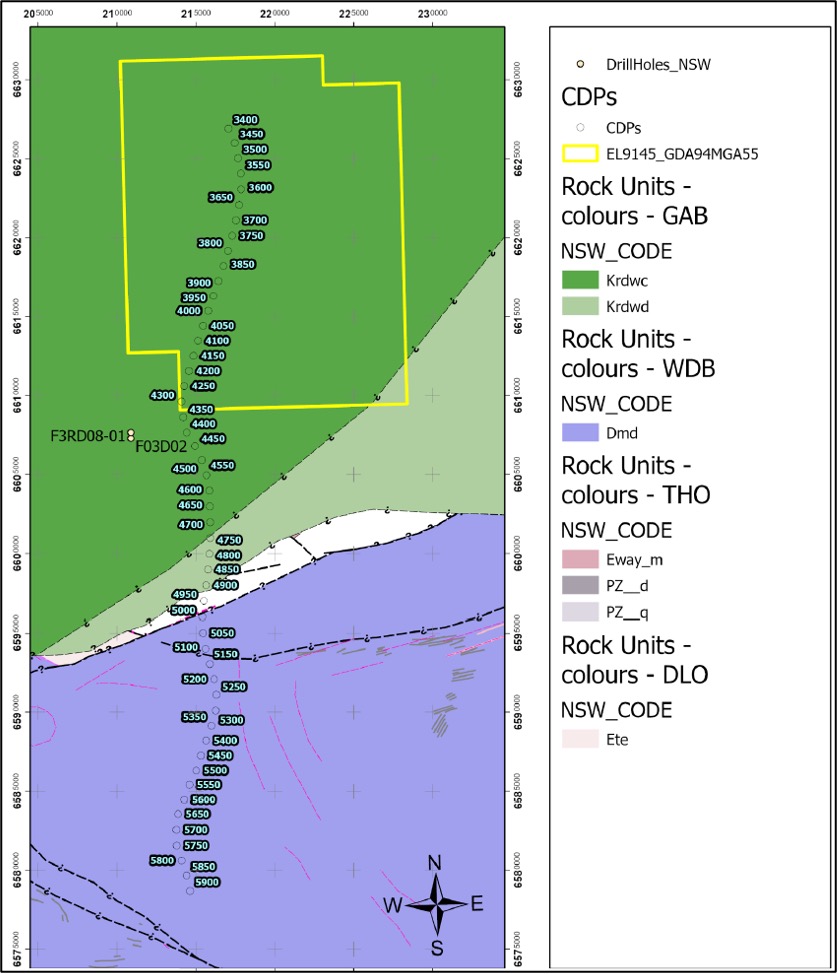
The EL9145 tenement, located approximately 50 km northwest of Tilpa, NSW, sits just north of the Olepoloko Fault. Mitre Geophysics have completed a comprehensive reinterpretation of seismic, gravity, and magnetic data, aiming to update geological models and assess mineral prospectivity.
The integration of reprocessed seismic line GA05-TL03 (2025), high-resolution aeromagnetic, and airborne gravity datasets provide new insights into the structural complexity and mineral potential of the area.
Geological Setting and Stratigraphy
EL9145 is characterized by a stacked succession of geological units:
- Quaternary alluvium: Unconsolidated sediments with weak reflectors, interpreted as alluvial deposits.
- Cretaceous Rolling Downs Group: Marine clastics, bright continuous reflectors, showing sag basin geometry and minimal faulting.
- Devonian Mulga Downs Group & Cobar Supergroup: Terrestrial clastics, semi-continuous reflectors within normal fault-bounded troughs, inverted and buckle folded, with major reverse/thrust faults from Tabberabberan and Kanimblan orogenies.
- Cambrian basement (Teltawongee/Warratta groups): Deformed turbidites and possible mafic volcanics, broad wavelength folded reflectors, interpreted as greenschist to amphibolite grade rocks.
Two alternative stratigraphic models are considered, differing mainly in the correlation of key packages to either Cambrian Warratta Group or Devonian Kopyje Group equivalents.
The Olepoloko Fault Zone, sitting just south of the tenement boundary, is a major structural feature, with imbricated slices and evidence of Neoproterozoic mafic volcanics.
Seismic Reprocessing and Structural Interpretation
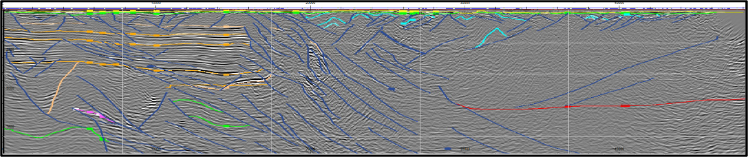
Reprocessing of the seismic line using tomographic velocity modelling has significantly improved imaging of near-surface structures, noise attenuation, and reflector positioning.
The seismic facies analysis reveals:
- Inverted normal faults, folding, and thrusting related to multiple orogenic events.
- Major unconformities and velocity boundaries, especially at the top of Devonian units.
- Imbricated slices within the Olepoloko Fault Zone, coincident with deep magnetic anomalies.
These improvements reduce uncertainty and enhance the image of a structurally complex exploration target area.
Geophysical Modelling: Gravity and Magnetics
Gravity-magnetic forward modelling achieved excellent fits (RMSg 1.7 mGal, RMSm 5.6 nT) using plausible densities and susceptibilities consistent with regional data. Key findings include:
- Deep magnetic sources (>500 m), explained by pyrrhotite-bearing units and possible mafic/intermediate volcanics or intrusions.
- Magnetic anomalies largely correspond to structural features and lithological boundaries, supporting the updated geological model.
Comparative tables of rock properties (density and magnetic susceptibility) from regional studies confirm the plausibility of assigned values for each stratigraphic unit. For example, Mulga Downs Group densities range from 2.44–2.50 t/m³, Winduck Group from 2.58–2.66 t/m³, and Teltawongee mudstones average 2.74 t/m³.
Magnetic Inversions and Anomaly Analysis
Three key magnetic anomalies have been inverted using both TMI and VRMI datasets:
- Anomalies 1 & 2: Large, deep-seated magnetic systems (>1.1 km depth), NW-trending, interpreted as deep intrusions or mafic-intermediate volcanics at the base of rift sequences. Susceptibility values range from 0.0034–0.006 SI.
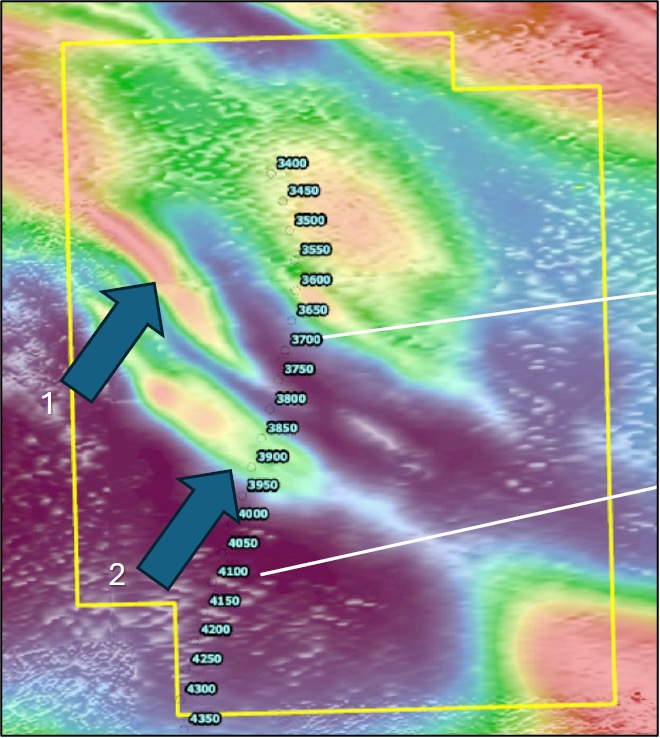
- Anomaly 3: Steeply dipping ovoid body, depth to top between 530–730 m, lateral extent ~1 km, interpreted as remanent pyrrhotite responsible for observed magnetic response. Drillholes intersected disseminated pyrrhotite at corresponding depths, confirming the geophysical interpretation.
The overall fit of inversion models is good, with minor misfits attributed to mixed induced and remanent magnetization effects.
Drilling Context and Mineralization
Historical drilling south of EL9145 (Minotaur 2008, Thomson 2013) targeted circular magnetic anomalies believed to be Cobar-style pipelike sulphide bodies.
Key outcomes from that drilling are:
- Intersection of pyrrhotite-pyrite mineralization in metasediments, with minor Zn-Pb-Ag anomalism but no economic results.
- Remanence studies on core samples indicated significant inductive conductivities and Königsberger Ratios, supporting the presence of remanent pyrrhotite.
- Further drilling east of EL9145 intersected interbedded psammite and pelite, with minor igneous intrusions and sphalerite-galena-pyrite mineralization, but again, no significant base metal or gold anomalism.
Mineral Prospectivity and Exploration Implications
EL9145 shares structural and lithological similarities with gold-prospective zones in the Stawell Belt (Victoria), Koonenberry region, and Cobar Basin. The presence of deep magnetic anomalies, inverted basins, and mafic volcanics/intrusions suggest potential for orogenic gold and Cobar-style base-metal systems.
However, stratigraphic ambiguities remain, particularly regarding the correlation of basement units (Cambrian vs. Devonian).
Further drilling is recommended to resolve these ambiguities and test mineralisation, especially in areas where magnetic anomalies coincide with structural complexity.
Integration of geophysical and geological data supports updated tectonic and exploration models for the southern Thomson Orogen margin.
Conclusions
- EL9145 is a complex, inverted basin with Neoproterozoic–Devonian stratigraphy and multiple orogenic overprints.
- Integrated seismic, gravity, and magnetic modelling provide a robust framework for exploration targeting.
- Magnetic anomalies appear to be explained by deep-seated mafic/intermediate units, but further drilling is needed to clarify stratigraphy and mineral potential.
- The area remains prospective for orogenic gold and Cobar-style base-metal systems, warranting continued exploration and integration of new data.